

G7+7 Petition on Forced Organ Harvesting: China’s Agenda and its Impact on Global Stability
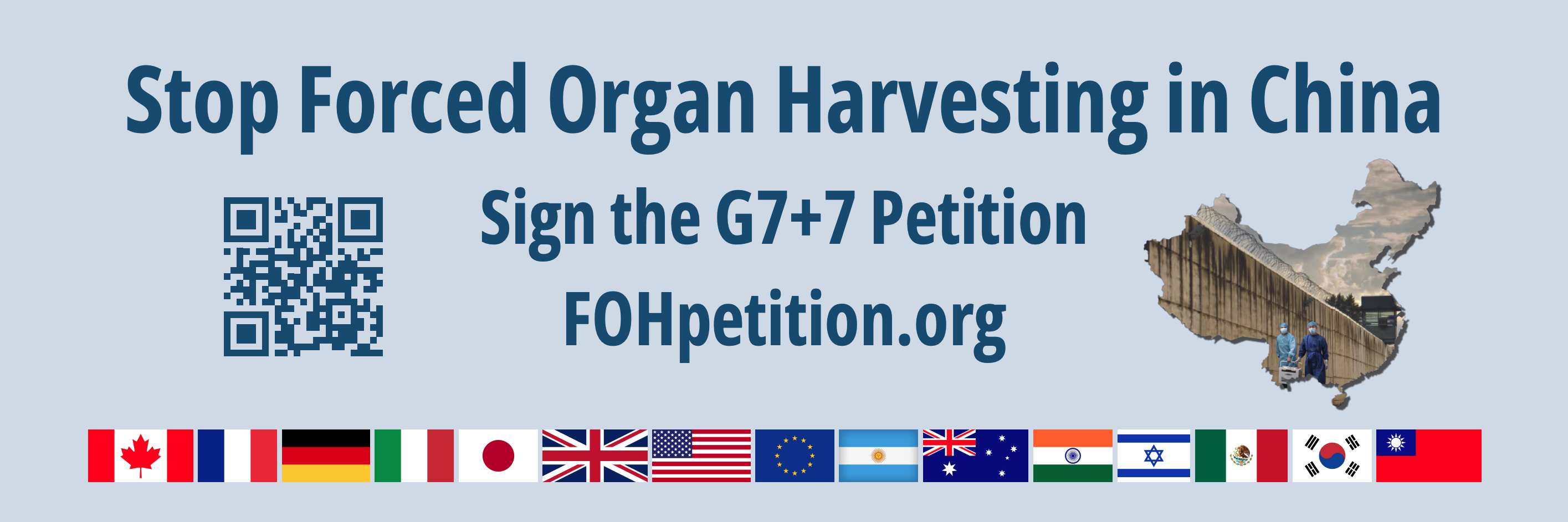
G7 Summit: An Opportunity to Address Forced Organ Harvesting, as World Leaders Become more Aware of the Global Instability Linked to China’s Growing Influence
China developed its organ transplantation system, in the absence of a verifiable and transparent organ donation program, violating fundamental ethical standards and committing crimes against humanity.”
WASHINGTON, DC,, WA, UNITED STATES, June 17, 2026 /EINPresswire.com/ -- The international G7 + 7 Petition calls on governments to take coordinated action in response to the human rights, ethical and global imbalances associated with the People’s Republic of China’s forced organ harvesting of Falun Gong practitioners, Uyghurs, Christians and other vulnerable groups at risk.— Torsten TREY,MD, Executive Director DAFOH
President Macron’s exchanges with President Xi and the Chinese government, prior to the G7 Summit in France in June 2026, aimed to address global economic imbalances between China and the rest of the world. China’s trade surplus with Europe reached $400 billion in 2025. At the same time, concerns about China’s role in a range of international challenges continue to grow. A brief look at current geopolitical developments raises the questions about China’s contribution to global stability and international norms.1
- It has been reported that China delivered parts needed for building drones, as well as other sanctioned items, to Iran and Russia. This has contributed to security concerns and regional instability in the Middle East and Europe.
- The export of fentanyl precursors to Mexican cartels has contributed to deaths and instability at the U.S.-Mexican border.2
China’s state subsidies to domestic industries have contributed to trade distortions and economic imbalances worldwide.3
- Tensions over Taiwan and the South China Sea have created significant geopolitical tensions and territorial disputes.4
Similar concerns can also be observed in the ethical and human rights arena. For more than 25 years, China has violated fundamental ethical standards and committed crimes against humanity against Falun Gong practitioners, Uyghurs, and potentially Christians and other vulnerable groups, by brutally persecuting and illegally harvesting organs. Forced organ harvesting in China should not be confused with organ trafficking, as the organ “donors” are being murdered during the organ procurement process.
Within two decades, China has significantly developed its organ transplantation system despite the absence of a verifiable and transparent organ donation program. Multiple lines of evidence show that a majority of the organs come from prisoners of conscience, dissidents and ethnic minorities. That has created profound ethical and medical imbalances undermining internationally accepted standards of human rights, medical ethics and organ transplantation.
Among all the concerns outlined above, calling out China for its forced organ harvesting crimes may be one of the most direct, immediate, and non-violent ways for the international community to hold China accountable.
The G7 Summit is a significant opportunity to affirm a fundamental principle: the governments of the G7 countries are elected bodies, meant to serve their citizens and promote respect for human rights, human dignity, and the sanctity of life.
In contrast, forced organ harvesting reflects a complete collapse of ethical standards in medicine. It turns medicine into a practice in which the tools of healing are used to deliberately end human life. No transplant system built on “killing for organs” can ever be considered legitimate.
In a previous petition to the UN Human Rights Council, our NGO, Doctors Against Forced Organ Harvesting, collected more than 3 million signatures across 50 countries and regions between 2012 and 2018. Through our new G7+7 Global Petition, we have collected over 600,000 signatures over the past two years. People who learn about these forced organ harvesting crimes are appalled by the lack of adequate international action addressing China’s transplant crimes.
The G7+7 petition calls on participating governments to issue a joint declaration condemning forced organ harvesting and demanding its immediate cessation. It further urges the implementation of a coordinated intergovernmental action plan, including measures to inform and protect citizens from becoming unknowingly complicit in these crimes through transplant tourism or related medical, research, and training activities.
1. China and the challenge to global order - November 2022. https://www.brookings.edu/articles/china-and-the-challenge-to-global-order/
2. China is still supplying drone factories in Iran, Russia despite U.S. sanctions - The Wall Street Journal - 5 May 2026. https://www.wsj.com/world/china-is-still-supplying-drone-factories-in-iran-russia-despite-u-s-sanctions-1e6820ca
3. Precursors, Ports, and Pills: Inside the China-Mexico-U.S. Fentanyl Supply Chain - University of Virginia - National Security Data and Policy Institute - 19 February 2026. https://nationalsecurity.virginia.edu/research/precursors-ports-and-pills-inside-china-mexico-us-fentanyl-supply-chain
4. China Primer: South China Sea Disputes - Congressional Research Service - 22 December 2025. https://www.congress.gov/crs-product/IF10607
Harold KING
Doctors Against Forced Organ Harvesting
+33 7 70 14 58 71
email us here
Visit us on social media:
Facebook
X
Legal Disclaimer:
EIN Presswire provides this news content "as is" without warranty of any kind. We do not accept any responsibility or liability for the accuracy, content, images, videos, licenses, completeness, legality, or reliability of the information contained in this article. If you have any complaints or copyright issues related to this article, kindly contact the author above.
