

Cell Cryopreservation Market to reach USD 90.92 Billion by 2035 at 19.8% CAGR
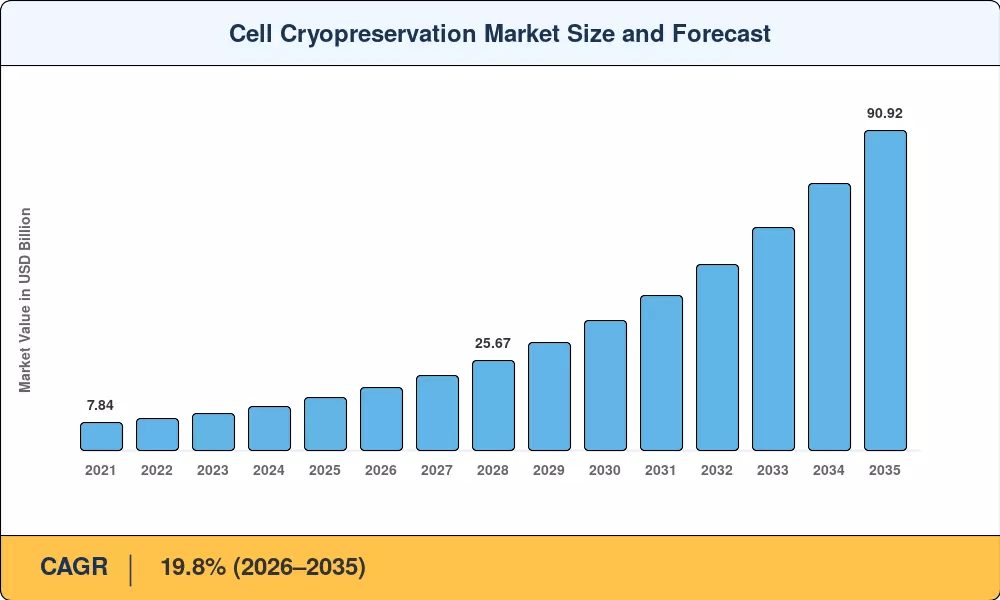
Cell Cryopreservation Market Size
Cell Cryopreservation Market to Surge from USD 17.89B in 2026 to USD 90.92B by 2035-By Cell & Gene Therapy Pipeline Scale-Up, Government Biobank Expansion
NY, CA, UNITED STATES, June 25, 2026 /EINPresswire.com/ -- As per Market Research Future, the global Cell Cryopreservation Market size to reach USD 90.92 Billion by 2035 from USD 17.89 Billion in 2026, at a CAGR of 19.8% during the forecast period 2026--2035. The market base was estimated at USD 14.93 Billion in 2025.The 19.8% CAGR---anchored by the rapid scale-up of cell and gene therapy (CGT) pipelines and government-backed biobank expansion programs---is driven by three converging forces: the commercial manufacturing scale-up of CGT products that creates recurring demand for validated cryogenic cell storage at every supply-chain node, sustained government biobank investment channeling billions into biological sample preservation infrastructure, and the technological shift from manual, rate-controlled freezing cabinets toward automated, closed-system cryogenic cell storage platforms and vitrification-based stem cell freezing technology that demonstrates superior post-thaw viability rates above 90%.
Request A Free Sample:
https://www.marketresearchfuture.com/sample_request/21534
Key Market Trends & Growth Drivers
Cell & Gene Therapy Manufacturing Scale-Up and Commercial Pipeline Expansion
By mid-2025, there were more than 1,900 active clinical trials in the global CGT pipeline, and between 2022 and 2024 alone, the FDA approved more than 20 novel cell and gene therapies. Validated cryogenic cell storage is necessary for every commercial CGT product at several supply-chain nodes, including the apheresis center, manufacturing suite, and point of care.
Because of this multiplier impact, each new CGT approval creates a recurring need for equipment and consumables used in biological sample preservation, making CGT commercialization the single biggest growth driver for the Cell Cryopreservation Market. BioLife Solutions' CryoStor line and Thermo Fisher's Gibco media portfolio have become de facto standards, attracting combined R&D investment exceeding USD 420 Million since 2022.
Government Biobank Expansion Programs and National Repository Networks
Initiatives for cryopreservation in national biobanking are expanding. While China's National Biobank Network planned a 2024--2028 investment of over USD 850 million to create 15 regional tissue repositories, the UK Biobank has over 1.1 million biological samples, facilitating longitudinal investigations. Over 300,000 people have signed up for the All of Us Research Program in the US, and cryopreservation service providers have been given hundreds of millions of dollars in sample storage contracts to handle the enormous volume of biospecimens.
India's National Biopharma Mission targets 20 new biorepositories by 2028, while Brazil's FAPESP program is funding five regional tissue banks. For cryopreservation media and equipment vendors, this transforms sporadic academic procurement into steady multi-year demand, smoothing the demand volatility that once made the Cell Cryopreservation Market difficult to forecast.
Vitrification Technology Innovation and Needle-Free Delivery Platforms Reshaping Administration
Legacy manual, rate-controlled freezing cabinets are giving way to automated, closed-system cryogenic cell storage platforms. Vitrification-based stem cell freezing technology has demonstrated superior post-thaw viability rates above 90%, displacing conventional slow-freeze protocols in IVF clinics and regenerative-medicine labs.
In areas where coverage is limited by post-thaw cell loss and protocol inconsistency, investment in vitrification and AI-driven bioprocess optimization is accelerating uptake. Machine-learning algorithms are being deployed to optimize freeze--thaw protocols in real time, adjusting cooling rates and cryoprotectant concentrations based on cell-type-specific viability data.
Ask for Customization:
https://www.marketresearchfuture.com/ask_for_customize/21534
Market Segment Insights
BY PRODUCT
Cryopreservation Media: Dominant segment with ~42% revenue share in 2025. Propelled by the shift toward chemically defined, xeno-free formulations. BioLife Solutions' CryoStor line and Thermo Fisher's Gibco media portfolio collectively serve over 70% of GMP manufacturing clients.
Updated FDA guidance (2024) and the EU Advanced Therapy Medicinal Products regulation revision (2025) increasingly require cryopreservation media used in clinical-grade manufacturing to meet full GMP certification, driving formulators to invest in xeno-free, chemically defined media---a premium product tier that commands margins 30--40% above research-grade alternatives.
Equipment: Fastest-growing product segment at an estimated CAGR of 21.3%, as automated controlled-rate freezers replace legacy manual units. A fully automated controlled-rate freezer with integrated monitoring can cost between USD 45,000 and USD 120,000 per unit, placing advanced cryogenic cell storage beyond the budget of many smaller research institutes and IVF clinics in developing economies. Leasing models and equipment-as-a-service contracts are emerging to address this barrier.
BY APPLICATION
Stem Cells: Dominant application with roughly USD 5.52 Billion in 2025, representing the highest absolute value within the Cell Cryopreservation Market. Driven by their central role in CGT manufacturing and the rapid expansion of cord-blood banking programs globally. Each new CGT approval creates a recurring need for equipment and consumables used in biological sample preservation.
Oocyte and Embryonic Cells: Fastest-growing application segment at a CAGR near 20.8%, reflecting a global surge in elective fertility treatments. Social egg freezing has grown at roughly 25% annually since 2020 across OECD nations, driven by employer-sponsored fertility benefits from companies including Apple, Google, and Meta. Vitrification yields push post-thaw survival rates beyond 95% in leading IVF clinics, displacing conventional slow-freeze protocols.
BY END USER
Biopharmaceutical Companies: Largest segment at ~38% share in 2025. Driven by validated biobanking cryopreservation requirements at each node of the CGT supply chain. Over 1,200 FDA-registered tissue establishments now require validated cryogenic cell storage systems, creating recurring demand for equipment and consumables.
Research Institutes: USD 3.43 Billion in 2025, serving as the primary beneficiaries of federally funded biorepository expansion programs including the NIH All of Us Research Program and UK Biobank partnerships.
Read Detailed Insights:
https://www.marketresearchfuture.com/reports/cell-cryopreservation-market-21534
Regional Outlook
North America --- Dominant Market (~38% Share, 2025)
The United States generates approximately 78% of North American Cell Cryopreservation Market revenue, driven by a combination of dense biopharmaceutical manufacturing clusters and federally funded biorepository networks. Over 1,200 FDA-registered tissue establishments now require validated cryogenic cell storage systems, creating recurring demand for equipment and consumables. The NIH All of Us Research Program, with over 300,000 enrollees, has awarded hundreds of millions of dollars in sample storage contracts.
Canada contributes through cord-blood banking expansion at a CAGR ~18.6%, while Mexico is growing on medical-tourism-driven IVF demand at USD 0.21 Billion in 2025. North America's leadership rests on reimbursement depth and the structural CGT manufacturing segment created by expanded FDA approvals and precision-medicine mandates.
Europe --- Second Largest (~27% Share, USD ~4.03 Billion, 2025)
Europe's Cell Cryopreservation Market reflects harmonized ATMP regulations that mandate GMP-compliant biological sample preservation across all member states. Germany leads regionally with Fraunhofer Institute biobank programs and a 2025 contribution of approximately USD 890 Million. The UK contributes through UK Biobank expansion to 1.1 million-plus samples at a CAGR ~19.1%. France contributes approximately USD 480 Million through its National Genomic Medicine Plan.
Italy contributes approximately USD 360 Million on stem cell therapy regulatory approvals and long-standing research infrastructure. Spain contributes approximately USD 280 Million on assisted reproduction sector growth. The Nordic countries hold ~8% of regional share through population-genomics biobanks. Russia holds approximately USD 190 Million through government regenerative medicine push. Harmonization pressure from ECDC guidance and EU Horizon funding is gradually lifting baseline demand across the region.
Asia-Pacific --- Fastest-Growing Region (~22.4% CAGR, 2026--2035)
Asia-Pacific is the engine of the Cell Cryopreservation Market. China holds the largest regional share with a 2024--2028 national biobank investment program earmarking approximately USD 850 million for 15 regional repositories, growing at approximately 21.5% CAGR. India is growing at approximately 24.8% CAGR on the back of IVF market liberalization, biopharma growth, and the National Biopharma Mission targeting 20 new biorepositories by 2028.
Japan contributes USD 0.52 Billion through regenerative medicine regulatory fast-track programs at approximately 19.3% CAGR. South Korea holds ~11% of regional share through cord-blood banking leadership. ASEAN economies show steep growth at approximately 21.5% CAGR on medical tourism and fertility services convergence. The rest of Asia-Pacific is growing at approximately 19.8% CAGR on emerging biobank infrastructure. The region's combined contribution anchors the global volume base for stem cell and fertility preservation demand.
Middle East & Africa --- Emerging Opportunity (~17.2% CAGR, 2026--2035)
The Middle East & Africa carries significant coverage gap and therefore steep opportunity. Saudi Arabia leads the region with Vision 2030 healthcare diversification, contributing the largest regional share at approximately 28%. The UAE is growing at approximately 19.5% CAGR on Dubai Healthcare City biobank projects. South Africa contributes USD 0.12 Billion on academic research biorepositories. Egypt holds ~10% of regional share on fertility services growth.
The rest of MEA is growing at approximately 15.8% CAGR on NGO-funded sample repositories. Gulf Cooperation Council states are investing heavily in healthcare infrastructure as part of economic diversification agendas, creating new greenfield demand for biobanking cryopreservation equipment and stem cell freezing technology across the Cell Cryopreservation Market. Cold-chain gaps remain a restraint---WHO estimates that last-mile failures in sub-Saharan Africa result in waste rates exceeding 10% in challenging regions.
South America --- Growing Presence (USD ~1.05 Billion, 2025)
Brazil anchors South America's Cell Cryopreservation Market at ~58% of regional revenue, with FAPESP-funded biological sample preservation programs and a growing private IVF sector that performed over 100,000 cycles in 2024, providing a stable demand floor that smooths regional forecasts. Argentina contributes through stem cell research programs at approximately 16.2% CAGR.
The rest of South America is growing steadily on hospital-based biobanking pilots at USD 0.18 Billion in 2025. South America's procurement runs largely through national research funding and hospital networks, which pool demand to secure competitive pricing. The region's stable demand base supports manufacturer volume planning even as per-unit tender prices compress margins.
Competitive Landscape and Recent Developments
The Cell Cryopreservation Market displays medium concentration, with the top five players accounting for an estimated 45--52% of global revenue. The Herfindahl--Hirschman Index (HHI) falls in the moderately concentrated range (~1,200--1,500), reflecting a mix of diversified life-science conglomerates and specialist cryobiology firms. Concentration is highest in high-income segments where regulatory and manufacturing barriers are steep; the emerging-market tier is more fragmented as regional producers compete on price.
The competitive landscape is stratified between full-spectrum platform leaders serving CGT manufacturing and private markets, media and consumables specialists capturing GMP-grade tenders, and equipment automation firms consolidating the biobank infrastructure segment.
KEY COMPANIES AND RECENT MILESTONES
Thermo Fisher Scientific (2024--2025): Maintains leadership with Gibco CTS media and CryoMed freezers, commanding ~12--15% of global Cell Cryopreservation Market revenue. Full-spectrum platform leader serving CGT manufacturing and biobank segments. In June 2024, expanded Gibco CTS cryopreservation media manufacturing at its Grand Island, NY facility, adding 40% capacity for biological sample preservation products.
Merck KGaA (2024--2025): CryoStor-licensed media and Millipore consumables anchor a strong global franchise, holding ~8--11% of global revenue. The company benefits from the structural GMP-grade media segment created by updated FDA guidance and EU ATMP regulation revisions. In March 2024, acquired a controlling stake in a Swiss cryobiology startup specializing in DMSO-free vitrification media, strengthening its stem cell freezing technology portfolio.
BioLife Solutions (2024--2025): CryoStor and evo Cold Chain Management platforms anchor a CGT cold-chain integrator position, holding ~7--10% of global revenue. The company's media formulations have become de facto standards in CGT manufacturing, attracting significant R&D investment since 2022.
Future Outlook: 2026--2035
By 2030, digital immunization registries will evolve into integrated biobank data platforms that become the operating system of biological sample preservation. WHO targets near-universal digital registry adoption across member states by the early 2030s, enabling sample-tracking and defaulter identification that lifts biobank utilization rates---the metric most correlated with Cell Cryopreservation Market growth.
Electronic sample management systems generate granular inventory data that manufacturers and biobanks can monetize through demand-forecasting and sample-tracking services, creating a new business model layered on top of the core biological sample preservation franchise.
AI-powered bioprocess optimization and autonomous cryopreservation operations will reframe cost structures by the early 2030s. As machine-learning algorithms optimize freeze--thaw protocols in real time and predictive maintenance reduces liquid-nitrogen storage tank failures, the addressable channel widens from centralized biobanks to decentralized clinical trial sites and community fertility clinics, extending cryogenic cell storage beyond traditional settings.
More Related Research Insights:
https://www.marketresearchfuture.com/reports/cell-therapy-market-5066
https://www.marketresearchfuture.com/reports/stem-cell-therapy-market-6422
https://www.marketresearchfuture.com/reports/regenerative-medicine-market-2220
https://www.marketresearchfuture.com/reports/biobanking-market-5967
https://www.marketresearchfuture.com/reports/cell-culture-media-market-4462
https://www.marketresearchfuture.com/reports/cryogenic-equipment-market-1266
https://www.marketresearchfuture.com/reports/gene-therapy-market-8399
https://www.marketresearchfuture.com/reports/personalized-medicine-market-2937
Larry Wilson
WantStats Research And Media Pvt. Ltd.
+1 855-661-4441
email us here
Visit us on social media:
LinkedIn
Facebook
YouTube
X
Legal Disclaimer:
EIN Presswire provides this news content "as is" without warranty of any kind. We do not accept any responsibility or liability for the accuracy, content, images, videos, licenses, completeness, legality, or reliability of the information contained in this article. If you have any complaints or copyright issues related to this article, kindly contact the author above.
